dinsdag 9 augustus 2011

Dr. Agus Setiabudi and reading of the Old Testament


Yesterday, 5 August 2011, Agus Setiabudi defended his doctoral dissertation at the Theological School of Kampen, officially the PThU, Protestantse Theologische Universiteit. The title of the dissertation is:
Taking its Shape. Towards an Indonesian Old Testament Theology. The book discusses the four volume work by Christoph Barth, son of the famous Karl Barth, who for about 25 years taught in Indonesia, Banjarmasin and Jakarta. His Theologia Perjanjian Lama is still reprinted and used at theological schools in Indonesia. Setiabudi analyzed this book, the English translation and some 20 dissertations by Protestants scholars of Indonesia. He concluded that the very strict orthodox theology of Christoph Barth is somewhat altered by the Indonesians: they have more feeling for the value of local traditions and do not see the Old Testament as an isolated truth, towering above all the sins and nonsense of human people, but try more to write biblical interpretation in harmony with their culture. This is a nice description of recent history of Indonesian Protestant theology.
Several readers were surprised to see that a similar book: Walter Lempp's multi-volume Tafsir Perjanjian Lama was not taken into consideration. In fact the two scholars share the same academic and spiritual tradition. Several readers were also surprised that the Catholics were not mentioned at all: no Cletus Groenen, John Prior, Stefanus Darmawijaya (with his nice comparison of the panakawan and the ebed Jahwe or Servant of God) and nothing about the much younger Jesuit Deshi Ramadhani.

Setiabudi wants a specific Indonesian Old Testament Theology and writes at various placed in his book that Islam must be an important context for Bible Interpretation. But I am afraid that he knows very little about the strong biblical background of the Qur'an, little about the extensive reference to Adam, Noah, Abraham, Moses, David and Jesus in the basic text of the Muslim community. In fact, biblical scholars could have an important role in the Indonesian contextual theology, but the European tradition is so strong, that not yet much can be seen here.


Gerrit Singgih will receive an honorary doctorate in Kampen in December. Congratulations! Gerrit was co-promotor in Kampen. Above he is shown together with Barend Drewes, for many years teaching New Testament interpretation in Indonesia.

There is a famous Latin proverb: Timeo hominem unius libri. It must be translated as: I fear someone who only reads/sticks to one book. Scripturalism is the word coined by Clifford Geertz for any style of orthodoxy that claims to return to the text of one book alone. In reality, it is always new interpretations that rise. We should be realistic and not stick to one book alone, Bible or Qur'an.

zaterdag 2 juli 2011

Susanne Schröter (ed), Christianity in Indonesia. Perspectives of power


Lit Verlag in Berlin recently published volume 12 in its series of Southeast Asian Minorities, still dated in 2010, 419 pages.

The book started with a conference in December 2003. Many contributions were written later. Quite a few by authors who did not attend the conference. I will not deal with all 13 articles, but only give my general impression and deal with some more in detail.

Schroter wrote two articles. First in introduction 'Christianity in Indonesia. An overview.' It is a summary of the history and deals also with the present political situation. It states openly that expansion of Christianity was part of colonialism 'It is hardly possible to draw a dividing line between proselytization and colonialism, even though missionaries and colonial officials did not always pursue the same interests.' (10) This is very short about a complex history! Sometimes it is somewhat apologetic for modern Christianity: Christianity has contributed to overcoming ethnic boundaries..'(15) and supported local resistance against a central government (like in Papua en Timor Leste).


Schroeter also has a very interesting article 'The Indigenization of Flores', on Ngada rituals. She distinguishes between top-down inculturation versus integration of Catholicism and traditional religion from below. A striking contrast is between Bishop Van Bekkum who argued in the 1950s already in favour of liturgy in local languages and Indonesian instead of Latin formulas. But this misa kerbau or buffalo mass was criticised by local Catholics who liked the Gregorian chants and Lstin Mass for its mysterious power (147). Many aspects of daily life are still untouched by Christianity and thus the Ngada of North Central Flores developed a 'religious parallel system' especially at weddings and funerals where Catholic international ritual is only a small part of a complex system. She described in details a yearly village festival reba umum as a mixture of Catholic mass, traditional ritual, governmental event and folkloristic performance (153).

Susanne Rodemeier writes on the island of Pantar, northwest of Timor and close to Alor. Like in many islands of East Indonesia there is a different religion on the coast and in the interior. In 'her' region of part of Pantar the coastal village is Muslim, while the upland area is Christian. This is already the case since centuries: after Islam arrived from the Moluccas in the 16th and 17th century (Ternate).

There is quite good communication between the two communities: they meet at religious festivals, help each other in restoring churches and mosques. Probably the Muslims also restored the traditional sanctuaries before the arrival of Christianity in early 20th century. The Muslims give a good reason for the difference: of course hill tribes cannot become Muslim, because they have no water in their neighbourhood. There are many interreligious marriages between Muslims and Christians, where the common rule is that istri ikut suami, wife follows the husband.


Rodemeier gives much attention to the myth of origin of the difference between Muslims and inland people. It was the first story she heard when she came for field research and there were many references to it later. This myth ends with rules for good relations: it is forbidden to utter any accusation agianst anyone who belongs to the group of the other party; parties are obliged to invite each other to their respective rituals.

I wrote also a contribution for the book: on the power of money, more specifically on the period 1965-1980 when development aid started in Western countries and the first to spend this money were churches with sometimes fantastic plans and often meager results.Birgit Bräuchler has an interesting article on the Internet in the Moluccan conflict, Lorraine Arragon on the Poso conflict. Dieter Bartels has a good summary of his viewpoint on traditional Ambonese society and the sudden conflicts, 1999-2004. Quite revealing is also the article by Sven Kosel on Minahasa and the Christian militant movements like Brigade Manguni, Legium Christum and quite a few others, not as innocent as they present themselves. Hassan Noorhaidi summarizes his dissertation on Laskar Jihad and Magnis Suseno defends an open interpretation of pluralism.
Olaf Schumann, Holger Warnk and Raymong Corbey have some more general historical contribution.
This is a fine collection of views on Christianity in Indonesia, seen not from the clerical or institutional church pulpits but from daily life of common people.

dinsdag 12 april 2011

Abdullahi Ahmed An-Na'im on Indonesia


My first ecnounter with a writing by Abdullahi Ahmad An-Na'im was on the campus of UIN (then still IAIN) Sunan Kalijaga in Yogyakarta. There were two heaps, each with some 20 copies of the translation of his book Dekonstruksi Syari'at. It is a well written argument for a reinterpretation of shari'a formulations, especially with regard to women and religious minorities. Basic idea is that the rulings of the Qur'an are partly from the prophetic period in Mecca, partly from the Medina period of Muhammad's life when he was a politican and had to make compromises.
Recently I bought the latest book, Islam, and the Secular State. Negotiating the future of Shari'a (Cambridge, MA and London: Harvard University Press 324 pp.). I was somewhat disappointed by the content. First about the general or international thesis of the book: An-Na'im does not want to see Islam as a 'pure' religion with prayers, rituals, concentrating on the idea of God, general rules of ethics. He wants to reject the secular society where religion is an individual affair. Why? That is not absolutely clear. It is more or less a deliberate choice that has been made outside the perspective of the book.
An-Na'im makes a sharp distinction between state en community: the territorial state must be secular, but the communities that live in the state and form together iyts society are welcome to live according to (renewed) shari'a:
As a Muslim I need a secular state in order to live in accordance with Shari'a out of my genuine conviction and free choice, personally and in community with other Muslims, which is the only valid and legitimate way of being a Muslim. Belief in Islam, or any religion, logically requires the possibility of disbelief, because belief has no value if it is coerced. If I am unable to disbelieve, I will not be able to believe. Maintaining institutional separation between Islam and the state while regulating the permanent connection of Islam and politics is a necessary condition for achieving the positive role of Shari'a now and in the future. (268)

An-Na'im did field work in three countries: Turkey, India and Indonesia. In all three he found many differences among present-day Muslims about the idea of sharia law. In Indonesia adat and therefore law is still very important. There is a trend towards more Wahhabi style strict interpretation of sharia, but also defence of Pancasila. His research in Indonesia was based on FGD: Focus-group discussion, organized by LKiS in Yogyakarta and they all reflect a wide variety of perspectives. There is 'constant negotiation over the role of Islam' (251) and no consensus about the outcome. Some 'confuse idealized Arab culture with Islam itself' (253) and there is application of sharia law in Aceh (257), but again here: widespread ambivalence among Indonesians. Nurcholis Madjid is often mentioned here, also his Islam Yes! Partai Islam, No! In short, no clear way out of the many debates about the theme.

The illustrations on top is about a 'dhimmi-guide' composed by right wing politicians who are afraid about the future domination of Europe by hardline Muslims.

donderdag 31 maart 2011

Highlight of Harmony: Berat

From 24-28 March 2011 I was with my wife Pauline in Tirana for a conference of the Hizmet movement also known as the Fethullah Gülen network for education, social emancipation and interreligious harmony. In various short stories I will record some impressions of this most interesting and revealing trip.

On Sunday 27 March we were, in a group of some 12 congress participants who would stay at least one day longer, taken to the harbour town Dürress and the beautiful old town of Berat, located in the south at a place where a river narrows and the two sides come together in a quite small valley with steep high walls on each side.
Our lovely guide that day was Birol Inaltekin, Principal of the Turgut Özal Memorial International School of Tirana. Birol is born in Istanbul, served as school teacher in Georgia and Macedonia. He married a wife from Kirgyzia. The couple has three boys who also joined us on the trip. First some pictures of the Inaltekin family:


The absolute top of this day was the old town of Berati, already mentioned in 216 BCE as Antipatrea. In 200 BCE the Romans called it Albanorum Oppidum because of the white colour of its stones. It has very old manuscripts, some with rich golden and silver illustrations. For some time it was a kingdom of its own, it was ruled by the Bulgaroians and since 1455 by the Ottomans. The West side of the old town is still mostly Christian, the East side is mixed with a Muslim quarter down, close to the river, but uphill the old town is mostly Christian. The museum with some nice icons from the 16th century by its most famous painter, Onufri.The guidebook listed some 17 churches and some ruins of mosques and the palace of the Turkish Pasha. In 2005 Berat has been listed as a world heritage site by Unesco.

This is the dormitory of a tèkè, so it looks like the dormitory of a pesantren in Indonesia, beautifully restored in the lower part of East Berat.

I asked several people in this town about this new building: a mosque? an orthodox church? Some suggested that it would become a grand church plus mosque, side by side. Birol suggested that it would become an orthodox university, or a common private university owned by an Orthodox, but it might be a Muslim as well. Things can be easily combined, until now at least!


Above a rare picture of Mrs and Mr Steenbrink together in front of the former Cathedral of Berat, now the Museum.


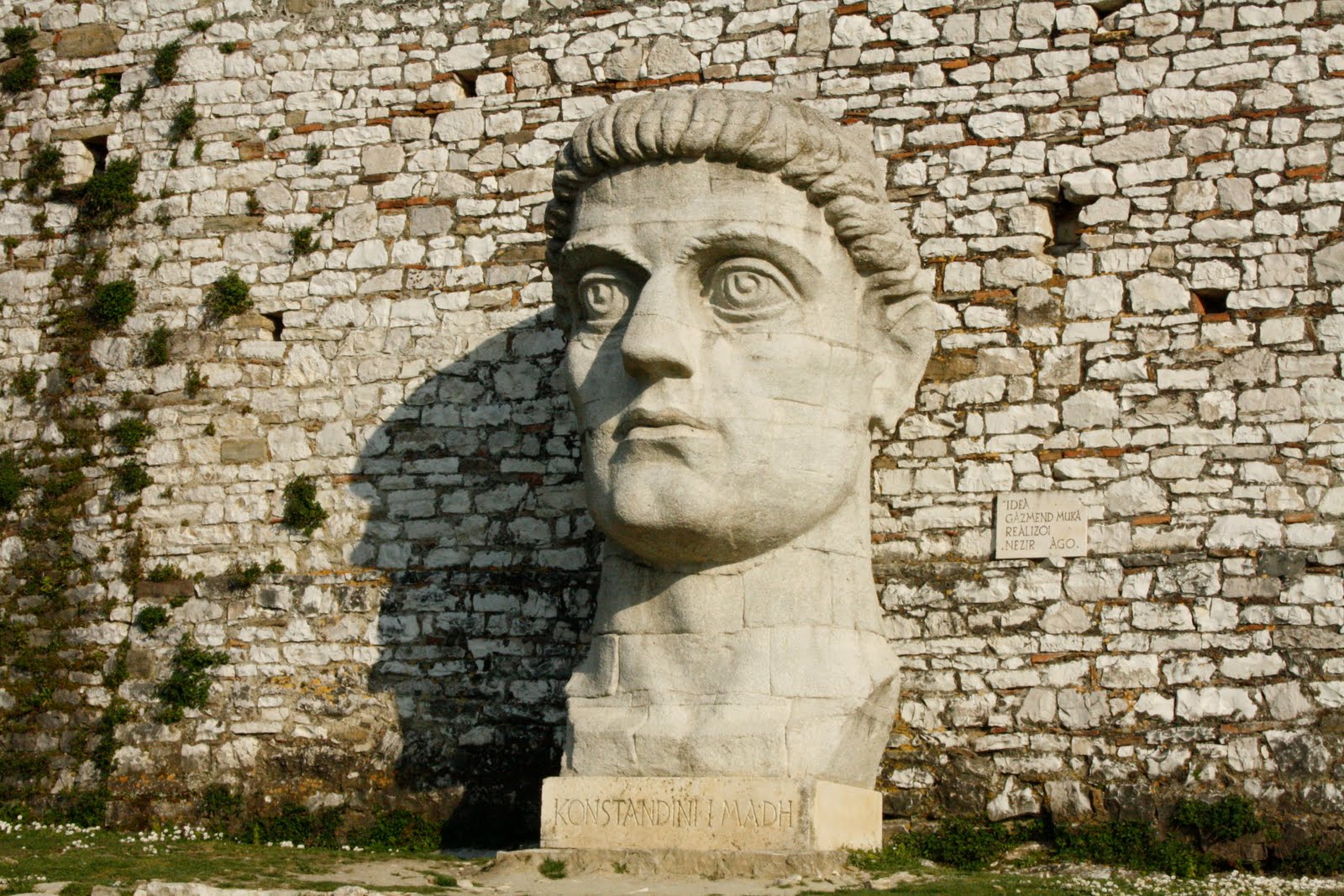
Well, let us conclude with the statue of big and great Constantine and a quote from Fethullah Gülen, according to Greg Barton:

State Islam – ‘Lausanian Islam’ - a product of the philosophy behind Turkey’s revolution
‘State Islam’ in Turkey was based on the conviction that the state was able to control religion – that it could shape and direct religious practice and belief through the application of law and institutions.
This meant that the state felt that it needed to maintain control over religious expression in the public sphere. This is accepted as a fact by Fethullah Gülen. He does not try or even hope to establish a totalitarian state where religion or religious leaders should control all aspect of political, social and individual life.

Bektashi

From 24-28 March 2011 I was with my wife Pauline in Tirana for a conference of the Hizmet movement also known as the Fethullah Gülen network for education, social emancipation and interreligious harmony. In various short stories I will record some impressions of this most interesting and revealing trip.

There was a Bektashi leader present during the full two days of the conference, we heard about them as more or less the equivalent of the Sunni Muslims, but the Gülen people could not tell us much about them. We heard that there was a tèkè just behind the Opera building (in very poor condition). Indeed, after asking here and there we found the graves, the reception room in a great walled garden. The guard was very willing to show us everything, but we could not talk to each other. We recited together al fatihah that was in calligraphy on the wall, but for the rest we only had communication through gestures.
The first buried here is Sheh Ali Pazari, 1581-1615. According to information from people at the conference the present leader has followed the secondary school, the Turkish College. He was not in the reception room, a place that apparently also is used for zikr events. A giant rosary or tasbih can be used by more than twenty people together, using them in a circle. There are drums and some other musical instruments. There was also a sword that partly can be used for flagellation in the Shi'ite style of the Muharram ceremonies. For the rest we just show here the pictures from this compound, still standing amidst the hussle of modern Tirana. Its neighbour is a modern office tower of some twenty floors!


Celebrating and Debating Hizmet/Fethulah Gülen

From 24-28 March 2011 I was with my wife Pauline in Tirana for a conference of the Hizmet movement also known as the Fethullah Gülen network for education, social emancipation and interreligious harmony. In various short stories I will record some impressions of this most interesting and revealing trip.
The two-day conference had, as is common with other conferences an overloaden programme. Much space was given to people who are 'fellow travellers' and not 'member' of the movement itself, and definitely non Muslim. Sometimes they even have priority: prominent Gülen specialist Ercan Karakoyun of the Berlin Dialogue Centre withdraw his paper, because of the large number of presentations. Here I present just a few notes from the presentations of the two days.
Muhammad Cetin (not present here) studied with Paul Weller at Derby University and wrote his thesis on the movement The Gulen Movement: Civic Service without Borders with Paul Weller in Derby, UK. Cetin now leads the Dialogue Institute in Houston. He was not present but instead there was Prof. Lynn Evans Mitchell from the University of Houston who looks very much Texan and celebrated the excitement, enthusiasm and perseverance of Gülen people in religious harmony and teaching towards upward social mobility.

Lynn Mitchell lost his luggage during a transit in Rome. He (and the other Americans) had much problems in their trip because of a snow storm in Washington. Their flight were delayed and diverted to other airports.

Prof. Francesco Zannini started his speech with the Vatican II texts on interreligious harmony (Nostra Aetate) and its reaction A Common Word. He interpreted the Maqasid shari'iyyah as some common ground in natural law. This was a plea for world peace, impossible without peace between religions.

This idea is in line with the presentation I gave myself, from a paper that I wrote together with Dr. Gürkan Celik. Above is picture where I show the book by Celik The Gülen Movement. Building Social Cohesion through Dialogue and Education.
The summary of our contribution is as follows:
In the modern debate about the position of Islam in Western countries, there are some circles of Islamic thinkers who perceive a true Islamic society from a rather stretched hard-line rhetoric based on literal interpretation. However, since the classical period of Islam there has been a second system of virtue-oriented Islamic ethics, which also resonated with the early Greek philosophical thinking of virtues. Ibn Miskawayh is perhaps the best known thinker representing Islamic Humanism as a basic morality striving for virtues, based on human self-development. Al-Ghazali used this system in his Ihya Ulumud-Din in true harmony with the common rulings of shari’a. An analysis of the writings of Fethullah Gülen shows that for ritual rulings (ibadat) the traditional prescriptions have to be followed, as contained in the shari’a law, but for social ethics (mu’amalat) Gülen leaves much space for personal interpretation and stresses a more humanistic ethics of virtues rather than the ethics based on strict literal interpretations of detailed commands. Especially for the debate of Islam in the Western world this is a very important issue, because we see that anti-Islamism is mostly directed towards this program of strict or even fundamentalist interpretation of shari’a. This paper concentrates on the historical roots of Gülen’s Sufism in the ethical-philosophical tradition of Islam. Besides, it wants to delineate how the differentiation between ibadat and mu’amalat can be formulated without confining religion into a form of spirituality solely based on absolute denial of the world.
German ambassador Günther Mulack emphasized the praize for Islam in the West since Johann Wolfgang Goethe and regretted islamophobia that rose since the attacks of 9/11. He called his address a message rather than an academic lecture and so was much of the conference: a celebration rather than a sharp debate.

An excellent lecture was given by Radhi Al-Mabuk on Forgiveness. He did not address the social and political issues of conflicts between countries and religions, but discussed parent-child relation, especially the traumatic effects of suicide for those who survive and first must struggle to understand the act of suicide before forgiveness can start. In my notebook I wrote: this is like the best of the psychological philosophy by existentialist Joseph Pieper!

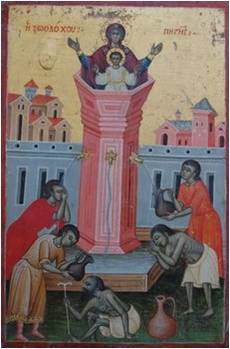
One of the very few female speakers was Prof. Ilira Caushaj from Tirana. She concentrated on the interreligious theme of the Gülen movement and showed it through pictures from churches in Berat. Here I give two examples (I could make a copy of her Powerpoint presentation). The first is a comparison of two icons: the older one from the 17th century only shows a background of some churches for the story of healing water. The second shows minarets and mosques as the background of Jesus and the Holy Virgin, healing through miraculous water.


The second example is from a fresco in one of the major churches of Berat and shows an orthodox priest talking with an imam (complete with turban).


Greg Barton, known as a specialist on modern Muslim movements in Indonesia, holds the Gülen chair at the Catholic University of Melbourne and presented a throrough portrait of the movement. From his powerpoint of 34 slides I quotes here just a few:
A new and different kind of Islamic movement:
Looks superficially like a Muslim Brotherhood movement;
But is profoundly different in its doctrine, outlook and in its approach to the state, society and the individual;
Grew out of the Nur Jamaat, opposed to Milli Gorus Islamism;
The Gülen movement rejects attempts to achieve coercive application of shar’iah by the state;
Rejects formal links between religion and politics;
Does not align itself with any party;
But individuals are often admiring of Erdogan and the AKP.

A non-islamist movement
Although socially conservative the Gülen movement stands in opposition to Milli Gorus Islamism
Seeks to improve society by developing individuals
Tolerant and appreciative of diversity
Seeks to promote change through inclusive activism
Through temsil, or example
Rather than through tabligh, or preaching

Gülen on education andthe life of the mind
The following statement from Gülen could just as easily have come from John Wesley or Jonathon Edwards or any number of Jesuit brothers:
“Neglect of the intellect … would result in a community of poor, docile mystics. Negligence of the heart or spirit, on the other hand, would result in crude rationalism devoid of any spiritual dimension … It is only when the intellect, spirit and body are harmonized, and man is motivated towards activity in the illuminated way of the Divine message, that he can become a complete being and attain true humanity.”

Reconciling two worlds
The world of traditional faith, the world of rural Anatolia:
rote learning and uncritical acceptance
certainty and clear values
taklid, tassawuf and tablig
The world of globalized modernity, the world of secular Istanbul, Izmir, Ankara and beyond reason, critical engagement and exploration of issues, ideas, society and the environment
dialogue and the steady evolution of thought
ijtihad, tajdid and of taklim

Muslim Puritans (= exactly the word James Peacok used for Muhammadiyah in Indonesia:
Hakan Yavus has described the members of the Gülen hizmet as being ‘Turkish Puritans’
In fact there are a number of strong parallels between the Puritans in general and the hizmet leaders and between Gülen and Puritan thinkers, such as:
Jonathan Edwards, Quaker thinkers such as John Woolman and, to some extent, Anglican thinkers such as John Wesley and Samuel Johnson
There is an even stronger correlation with subsequent movements in Christian education, both Protestant and Catholic, through to the present time.

woensdag 30 maart 2011

Turkish Colleges and Epoka University in Tirana

From 24-28 March 2011 I was with my wife Pauline in Tirana for a conference of the Hizmet movement also known as the Fethullah Gülen network for education, social emancipation and interreligious harmony. In various short stories I will record some impressions of this most interesting and revealing trip.

We arrived on Thursday 24 March. That same evening a meeting and dinner was planned at the campus of Epoka University, some 20 km south of Tirana, only ate 3 minutes drive from the International Airport. The second day (at the end of the first day of the conference) we went to the most prestigious of the "Turkish Colleges' in Tirana, named after Turgut Özal, Prime Minister between 1983-9 and the President of Turkey until his death in 1993. He was praised as the first 'non-Kemalist' politician after many presidents from the military.
Epoka University is relatively small: not much more than 2000 students and it does not want to become much bigger. It concentrates on Economics, Computer Science/ICT, Civil Engeineering, architecture. Our main leader, here and during many of these days was Armando, a young engineer who had studied at the first Turkish College in Tirana (the özal College, also called the Memorial International School of Tirana). Armando is fluent in English, but also in Italian and Spanish. He is a civil engineer who worked for some ten years in several projects, among these the building of the international airport of Tirana. He moved to Epoka University in 2009. He wants to start his Ph.D. soon, on the topic of the restauration of post-Byzantine churches in Albania. His wife is also a civil engineer. She was prominent in the preparation of the recognition of Berat as a UNESCO World Heritage Site. His wife is still working at the government department of cultural heritage. They have one boy (born about the same time a our granddaughter Sophie, late 2009).

Armando Demaj

Epoka University has several buildings in Tirana City, but has started a new campus on a nice piece of land quite close to the international airport in a region that is otherwise still empty land, along a nice small lake. This is a view the resembles the Fatih University of Istanbul, although everything here is on a smaller scale. The name Epoka means Epoch and it must be the start of a new epoch in the history of Albania. Like Fatih University there is also no theological faculty, even no facility to say prayers, no mosque (yet). We had lunch here on the day of departure and at least half the students were female. None of them with a veil: this all looks quite secular and gives the impression that this undertaking is more a development or emancipation effort than something of a strengthening of the Islamic character of Albania.


People sitting at the table below: Mrs and Prof. Admiel Kosman of Berlin, Jewish Studies; Ercan Karakoyun of the Berlin Dialogue Centre; Rector and the Dean of Ecnomics of Epoka University; Prof. Radhi al-Mabuk, Psychologist in University of Northern Iowa, of Saudi Arabian origin and close to the Gülen movement. Second table, looking on his back Dr. Günther Mulack, German diplomat, former ambassador in various capitals of the Middle East and first German Ambassador for the contacts with Islam.

The second evening we visited Turgu özal College where we saw a show of students who read poetry, did some singing and dancing, both in pop-style as traditional. It is a secondary school that started in 1993 as the first of the 'Turkish Colleges' that are the trademark of the Gülen people in Albania: teaching at an international level in English, much emphasis on science, architecture, economics and computers. Below some photographs of the new buildings and the show.


Here we see Dr. Pauline Maas-Steenbrink talking with Mustafa Erdem, Dean of Students at Epoka University. From our arrival in Tirana until departure he was, together with Armando Demaj our guide. Mustafa Erdem originates from Istanbul, and he is one of a quite good number of people from Turkey serving the Gülen activities in Albania.