donderdag 31 maart 2011

Celebrating and Debating Hizmet/Fethulah Gülen

From 24-28 March 2011 I was with my wife Pauline in Tirana for a conference of the Hizmet movement also known as the Fethullah Gülen network for education, social emancipation and interreligious harmony. In various short stories I will record some impressions of this most interesting and revealing trip.
The two-day conference had, as is common with other conferences an overloaden programme. Much space was given to people who are 'fellow travellers' and not 'member' of the movement itself, and definitely non Muslim. Sometimes they even have priority: prominent Gülen specialist Ercan Karakoyun of the Berlin Dialogue Centre withdraw his paper, because of the large number of presentations. Here I present just a few notes from the presentations of the two days.
Muhammad Cetin (not present here) studied with Paul Weller at Derby University and wrote his thesis on the movement The Gulen Movement: Civic Service without Borders with Paul Weller in Derby, UK. Cetin now leads the Dialogue Institute in Houston. He was not present but instead there was Prof. Lynn Evans Mitchell from the University of Houston who looks very much Texan and celebrated the excitement, enthusiasm and perseverance of Gülen people in religious harmony and teaching towards upward social mobility.

Lynn Mitchell lost his luggage during a transit in Rome. He (and the other Americans) had much problems in their trip because of a snow storm in Washington. Their flight were delayed and diverted to other airports.

Prof. Francesco Zannini started his speech with the Vatican II texts on interreligious harmony (Nostra Aetate) and its reaction A Common Word. He interpreted the Maqasid shari'iyyah as some common ground in natural law. This was a plea for world peace, impossible without peace between religions.

This idea is in line with the presentation I gave myself, from a paper that I wrote together with Dr. Gürkan Celik. Above is picture where I show the book by Celik The Gülen Movement. Building Social Cohesion through Dialogue and Education.
The summary of our contribution is as follows:
In the modern debate about the position of Islam in Western countries, there are some circles of Islamic thinkers who perceive a true Islamic society from a rather stretched hard-line rhetoric based on literal interpretation. However, since the classical period of Islam there has been a second system of virtue-oriented Islamic ethics, which also resonated with the early Greek philosophical thinking of virtues. Ibn Miskawayh is perhaps the best known thinker representing Islamic Humanism as a basic morality striving for virtues, based on human self-development. Al-Ghazali used this system in his Ihya Ulumud-Din in true harmony with the common rulings of shari’a. An analysis of the writings of Fethullah Gülen shows that for ritual rulings (ibadat) the traditional prescriptions have to be followed, as contained in the shari’a law, but for social ethics (mu’amalat) Gülen leaves much space for personal interpretation and stresses a more humanistic ethics of virtues rather than the ethics based on strict literal interpretations of detailed commands. Especially for the debate of Islam in the Western world this is a very important issue, because we see that anti-Islamism is mostly directed towards this program of strict or even fundamentalist interpretation of shari’a. This paper concentrates on the historical roots of Gülen’s Sufism in the ethical-philosophical tradition of Islam. Besides, it wants to delineate how the differentiation between ibadat and mu’amalat can be formulated without confining religion into a form of spirituality solely based on absolute denial of the world.
German ambassador Günther Mulack emphasized the praize for Islam in the West since Johann Wolfgang Goethe and regretted islamophobia that rose since the attacks of 9/11. He called his address a message rather than an academic lecture and so was much of the conference: a celebration rather than a sharp debate.

An excellent lecture was given by Radhi Al-Mabuk on Forgiveness. He did not address the social and political issues of conflicts between countries and religions, but discussed parent-child relation, especially the traumatic effects of suicide for those who survive and first must struggle to understand the act of suicide before forgiveness can start. In my notebook I wrote: this is like the best of the psychological philosophy by existentialist Joseph Pieper!

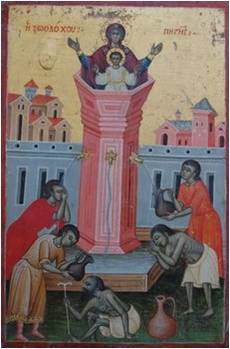
One of the very few female speakers was Prof. Ilira Caushaj from Tirana. She concentrated on the interreligious theme of the Gülen movement and showed it through pictures from churches in Berat. Here I give two examples (I could make a copy of her Powerpoint presentation). The first is a comparison of two icons: the older one from the 17th century only shows a background of some churches for the story of healing water. The second shows minarets and mosques as the background of Jesus and the Holy Virgin, healing through miraculous water.

The second example is from a fresco in one of the major churches of Berat and shows an orthodox priest talking with an imam (complete with turban).


Greg Barton, known as a specialist on modern Muslim movements in Indonesia, holds the Gülen chair at the Catholic University of Melbourne and presented a throrough portrait of the movement. From his powerpoint of 34 slides I quotes here just a few:
A new and different kind of Islamic movement:
Looks superficially like a Muslim Brotherhood movement;
But is profoundly different in its doctrine, outlook and in its approach to the state, society and the individual;
Grew out of the Nur Jamaat, opposed to Milli Gorus Islamism;
The Gülen movement rejects attempts to achieve coercive application of shar’iah by the state;
Rejects formal links between religion and politics;
Does not align itself with any party;
But individuals are often admiring of Erdogan and the AKP.

A non-islamist movement
Although socially conservative the Gülen movement stands in opposition to Milli Gorus Islamism
Seeks to improve society by developing individuals
Tolerant and appreciative of diversity
Seeks to promote change through inclusive activism
Through temsil, or example
Rather than through tabligh, or preaching

Gülen on education andthe life of the mind
The following statement from Gülen could just as easily have come from John Wesley or Jonathon Edwards or any number of Jesuit brothers:
“Neglect of the intellect … would result in a community of poor, docile mystics. Negligence of the heart or spirit, on the other hand, would result in crude rationalism devoid of any spiritual dimension … It is only when the intellect, spirit and body are harmonized, and man is motivated towards activity in the illuminated way of the Divine message, that he can become a complete being and attain true humanity.”

Reconciling two worlds
The world of traditional faith, the world of rural Anatolia:
rote learning and uncritical acceptance
certainty and clear values
taklid, tassawuf and tablig
The world of globalized modernity, the world of secular Istanbul, Izmir, Ankara and beyond reason, critical engagement and exploration of issues, ideas, society and the environment
dialogue and the steady evolution of thought
ijtihad, tajdid and of taklim

Muslim Puritans (= exactly the word James Peacok used for Muhammadiyah in Indonesia:
Hakan Yavus has described the members of the Gülen hizmet as being ‘Turkish Puritans’
In fact there are a number of strong parallels between the Puritans in general and the hizmet leaders and between Gülen and Puritan thinkers, such as:
Jonathan Edwards, Quaker thinkers such as John Woolman and, to some extent, Anglican thinkers such as John Wesley and Samuel Johnson
There is an even stronger correlation with subsequent movements in Christian education, both Protestant and Catholic, through to the present time.

woensdag 30 maart 2011

Turkish Colleges and Epoka University in Tirana

From 24-28 March 2011 I was with my wife Pauline in Tirana for a conference of the Hizmet movement also known as the Fethullah Gülen network for education, social emancipation and interreligious harmony. In various short stories I will record some impressions of this most interesting and revealing trip.

We arrived on Thursday 24 March. That same evening a meeting and dinner was planned at the campus of Epoka University, some 20 km south of Tirana, only ate 3 minutes drive from the International Airport. The second day (at the end of the first day of the conference) we went to the most prestigious of the "Turkish Colleges' in Tirana, named after Turgut Özal, Prime Minister between 1983-9 and the President of Turkey until his death in 1993. He was praised as the first 'non-Kemalist' politician after many presidents from the military.
Epoka University is relatively small: not much more than 2000 students and it does not want to become much bigger. It concentrates on Economics, Computer Science/ICT, Civil Engeineering, architecture. Our main leader, here and during many of these days was Armando, a young engineer who had studied at the first Turkish College in Tirana (the özal College, also called the Memorial International School of Tirana). Armando is fluent in English, but also in Italian and Spanish. He is a civil engineer who worked for some ten years in several projects, among these the building of the international airport of Tirana. He moved to Epoka University in 2009. He wants to start his Ph.D. soon, on the topic of the restauration of post-Byzantine churches in Albania. His wife is also a civil engineer. She was prominent in the preparation of the recognition of Berat as a UNESCO World Heritage Site. His wife is still working at the government department of cultural heritage. They have one boy (born about the same time a our granddaughter Sophie, late 2009).

Armando Demaj

Epoka University has several buildings in Tirana City, but has started a new campus on a nice piece of land quite close to the international airport in a region that is otherwise still empty land, along a nice small lake. This is a view the resembles the Fatih University of Istanbul, although everything here is on a smaller scale. The name Epoka means Epoch and it must be the start of a new epoch in the history of Albania. Like Fatih University there is also no theological faculty, even no facility to say prayers, no mosque (yet). We had lunch here on the day of departure and at least half the students were female. None of them with a veil: this all looks quite secular and gives the impression that this undertaking is more a development or emancipation effort than something of a strengthening of the Islamic character of Albania.


People sitting at the table below: Mrs and Prof. Admiel Kosman of Berlin, Jewish Studies; Ercan Karakoyun of the Berlin Dialogue Centre; Rector and the Dean of Ecnomics of Epoka University; Prof. Radhi al-Mabuk, Psychologist in University of Northern Iowa, of Saudi Arabian origin and close to the Gülen movement. Second table, looking on his back Dr. Günther Mulack, German diplomat, former ambassador in various capitals of the Middle East and first German Ambassador for the contacts with Islam.

The second evening we visited Turgu özal College where we saw a show of students who read poetry, did some singing and dancing, both in pop-style as traditional. It is a secondary school that started in 1993 as the first of the 'Turkish Colleges' that are the trademark of the Gülen people in Albania: teaching at an international level in English, much emphasis on science, architecture, economics and computers. Below some photographs of the new buildings and the show.


Here we see Dr. Pauline Maas-Steenbrink talking with Mustafa Erdem, Dean of Students at Epoka University. From our arrival in Tirana until departure he was, together with Armando Demaj our guide. Mustafa Erdem originates from Istanbul, and he is one of a quite good number of people from Turkey serving the Gülen activities in Albania.

25-26 March 2011 Fethullah Gülen Experience as a Model and Interfaith Harmony in Albania

From 24-28 March 2011 I was with my wife Pauline in Tirana for a conference of the Hizmet movement also known as the Fethullah Gülen network for education, social emancipation and interreligious harmony. In various short stories I will record some impressions of this most interesting and revealing trip.
The conference started on Friday 25 March in the five stars Sheraton Hotal of Tirana. The morning sessions were for political, social leaders and religious leaders. The Minister of Tourism, Culture, Youth and Sports, the rector of Tirana University and the rector of the Gülen-related Fatih University of Istanbul were the first speakers.


Paule Weller, one of the most outspoken Fellow-travellers

In the good Gülen tradition there was also one 'fellow-traveller' among the first group, Prof. Paul Weller of Derby University UK, a Baptist Minister, who was one of the very few people in the conference to speak in mild, fluid and pleasant English. We has to listen to sometimes good, often incomplete translations or to people who, like I myself, struggle with English as their second or third language.
The second morning session showed the Chief of the Muslim Community of Albania and his colleague from Kosovo. In the last decades the government has reassumed the Ottoman system of recognising chiefs of the various religious communities. Religious aducation seems to be still rather modest, but there is a special system for secondary schools, resembling the Imam Khatib Lysee of Turkey where a training for Imam (with much attention to Muslim rituals, chanting of the Qur'an, study of Arabic, Islamic law and history) is given besides secular education. The supervision for this type of school has been given to the Gülen community of Albania. Gülen people who were present at the conference were mostly involved in the 15 secondary schools that are labelled as 'Turkish Colleges', excellent secondary schools where a large part of education is taught in English, and where no religious education is taught.
Besides the Sunni leaders of Albania and Kosovo a representative of the Bektashi order was sitting. The latter (in white cassock) was quite impressive in body and dress, besides the tiny and modest Roman Catholic Bishop.
I talked to one student who confessed that he was born in a Bektashi family, but now turned into a practising Sunni Muslim: no alcohol, no visits to holy graves and not leaving the prayers and the fast of Ramadan to your shaykh but performing all this yourself.
The orthodox representative was not present on this first day of the conference, but he arrived on Saturday. 25 March is Feast of the Annunciation for the Orthodox and therefore they could not come the first day.


Mustafa Ozcan, rector of Fatih University in Istanbul, the most prominent institution of the Gülen Movement. We had the impression that the conference was brought together because of the finalisation of the first first grand building of its Albanian smaller equivalent, Epoka University.


Mons. Rrok Mirdita, Archbishop of Tirana, looking quite modest or even shy between the dignitaries of Sunni Muslims and Bektashi patriarchs


Haxhi Selim Muca, head of the Sunni Muslim community has known difficult times during the communist period, but he looks now as if his finest hour has come and he feel happy here.


The religious leaders did not speak in English, but in Albanian. I could have a quiet talk later with the Orthodox representative, but the Suuni and Bektashi representatives did not speak English and so communication was quite difficult. The Bektashi leaders as shown here had quite impressive attributes that were not yet clear to me, like many elements of the Bektashi spirituality also were unclear to most of my hosts. But from all of these it became clear that they stand for interreligious harmony, for good understanding of each other, besides promoting the interests of their own community, under supervision and direction of an open new Albania. All foster the dream of becoming a member of the European Union, that was often hears as a more or less messianic dream. Also the Ottoman policy of accepting the various communities besides official Sunni Islam, was often praised.

The new face of downtown Tirana

From 24-28 March 2011 I was with my wife Pauline in Tirana for a conference of the Hizmet movement also known as the Fethullah Gülen network for education, social emancipation and interreligious harmony. In various short stories I will record some impressions of this most interesting and revealing trip.


Tirana was the capital of the most severe communist country in the period 1950-1990. All churches, all mosques but one, various holy places of the Bektashi movement were destroyed. The centre of the town was reconstructed with broad, empty alleys, fit for the monstrous demonstrations that we know also from North Korea. People of Tirana compare that Stalinist period under Enver Hoxha (died 1985) now also the with present North Korean situation. The most curious building along the broad central lane is the Pyramid, designed as the mausoleum for the Communist leader, who is now replaced to a private grave only known to his family. There are not yet final plans for the building under the new constitution since the collapse of Communism in 1991.


There is a tremendous building activity in the whole country. In the centre of Tirana the major square, the Iskandar Beg, is closed for this reconstruction. On a side rode a sober, new Roman Catholic Cathedral has been built with on its front a statue of Sister Teresa, an icon for Albania. Also the international airport has been named after her.


The only remaining mosque from the pre-communist period is a rather small but very refines building in Ottoman style. Next to the mosque is a clock building from the 17th century. The paintings reminded us to the inner court of the Ummayad mosque in Damascus with nice buildings and splendid gardens, evoking dreams of paradise. The mosque is evidently much too small for the Friday prayers and a good number of faithfull was standing and bowing outside on a small square, still left free, while the attaching Iskandar Beg square is now closed for recontrsuction.
Not so far from this central mosque we visited the shrine of the Bektashi Teke, that will be discussed in a special issue of this blog. In fact there are four major religious groups in Albania: Sunni Muslims live besides Bektashi (or Alevi) Muslims, while Roman Catholics live besides the Orthodox. Percentages given are 70% for Muslims in total, 20% for the Orthodox and 10% for the Catholic community.
But we had the impression that Albanians are not too fanatic about religion and at the time of the Friday prayers the number of those who joined the only mosque in Central Tirana was not really impressive. The government is now giving room for expressions of religion. However, the plans for a grandiose Islamic Centre is still waiting for permission from the municipality, while the Catholic and Orthodox already could build spacious new churches. One informant told us that the mayor now is an Orthodox Christian, but this was doubted by other informants.
The new orthodx is nearly finished. It stand just of the Iskandar Beg square, just on the opposite side of the mosque. Whatever the personal faith of the new Albanians may be, religions have now become very visible again in the Albanian capital!

The new face of downtown Tirana

From 24-28 March 2011 I was with my wife Pauline in Tirana for a conference of the Hizmet movement also known as the Fethullah Gülen network for education, social emancipation and interreligious harmony. In various short stories I will record some impressions of this most interesting and revealing trip.

Tirana was the capital of the most severe communist country in the period 1950-1990. All churches, all mosque but one, various holy places of the Bektashi movement were destroyed. The centre of the town was reconstructed with broad, empty alleys, fit for the monstrous demonstrations that we known from North Korea. People of Tirana compare that Stalinist period under Enver Hoxha (died 1985). The most curious building along the broad central lane is the Pyramid, designed as the mausoleum for the Communist leader, who is now replaced to a private grave only known to his family. There are not yet final plans for the building under the new constitution since the collapse of Communism in 1991.

dinsdag 21 december 2010

Big Words: Merry Christmas and Happy New Year 2011


This is our more or less traditional end-of-the-year letter with a short report of our present condition and best wishes for all our friends. As to the first theme: there are so many blogs written here that we feel it not necessary to give more information. Paule and Karel are happy to stay in good mental and physical health (the only major inconvenience this year was the broken arm of Paule due to the heavy snow early this year). We were very happy with the same condition for our children with one more serious exception: Irene Vink, wife of Stijn, had a very serious injury in her left knee in a bicycle incident in The Hague, where here bicycle entered the rail of the local tram. She fell in an unlucky way and had to stay at home for nearly three months, still working through electronic means and only few times visiting the office of her company. Our granddaughter Sophie is a happy and eager small girl, thoughtful and quiet. She gives us and her parents Irene and Stijn much joy.
Floris and Inge are doing very well too in Amsterdam. They finished the renovation of their house and cared for the spacious garden, stayed in good physical condition with running, cycling and skating.
Karel was quite busy with work in Kampen (until August, replacement for a colleague with a sabbatical) and for courses for adult people. The last candidate for a doctoral dissertation, Fredrik Doeka, stayed in our house for two months (September-October) and all this work prevented Karel from writing seriously for the 3d volume of Catholics in Indonesia. But two books will be published soon: the English translation of The Jesus verses in the Qur'an and a commentary on the 2d Sura of the Qur'an.

In our Dutch weblog I wrote a meditation on the discussion we had in our Church of St John, related to the inauguration speech of Jesus in Luke 4,14-21: where he announces a man who receives the Spirit of the Lord, anointment and will bring good news to the poor, prisoners and the blind. The people of Nazareth are not convinced and remain quite sceptical. The Prince of Peace he is called and also the angels, according to the story of Christmas, sing about peace on earth. But what has become reality after this declaration of a new programme? Not everything of these promise has been realized, even quite little. Therefore no traditional sweet image of Mary and Jesus, but an angry Mary who punished this little Lord Jesus!

This is a painting by Max Ernst from 1926. Maria has a red underdress(indicating the divine character of Jesus) and then a blue robe (for the full human nature of Jesus). Jesus´ crown has fallen and so he becomes a common child. There are three witnesses± friends of Max Ernst. Not all Big Words of Jesus and his biographers have been realized. We must be happy with the small things, the rays of light that we see in this world. We are more than satisfied with that and we wish all our readers a reasonable portion of this light and happiness.
With best wishes for 2011!! Karel and Pauline Steenbrink

maandag 13 december 2010

Syrian Backgrounds


This contribution to the weblog has been written as a report at the end of the year 2010 on personal and family matters. We are happy to communicate that we had a rather quiet year. There were some physical inconveniences: Paule broke her right arm during the heavy snow of January-February but it is now Ok again. Irene, wife of Stijn, fell in September in The Hague, while getting into a tram rail. This was a very serious injury because the knee was broken at several weak points. She was operated and bound to her house and her bed for nearly two months and is now recovering slowly. With the baby Sophie in the house this was quite difficult sometimes and we went more often than before The Hague. It brought us also closer to the first granddaughter.
Our activities were as before: Karel taught frequently for the Senior Academy of Eindhoven en Doetinchem, sometimes for his former faculty and for various occasions. Fredrik Doeka was in our house for two months between 24 August August and late October. We do hope that his thesis on Moses in Indonesian Muslim and Christian Discourse can be defended in 2011.
We made shorter and two longer trips. One longer trip was to the United States in June. From 26 November-5 December 2010 we travelled for ten days in Syria. Here we show you the two of us against a Syrian background. We first stayed two nights in Damascus and then drove a small Hyundai to Palmyra, Aleppo, Hama to return for three more days in Damascus, a twon of 7 million people )ten times as much as in 1970!'
Damascus and Aleppo have been cities for more than 3000 years. This is most visible in the great Ummayad Mosque of Damascus: once it was a temple for the Fenician deity Haddad, for the Roman Jupiter, the Greek Zeus, for Jesus and Mary as a Byzantine Cathedral of Saint John the Baptist and now a mosque that still has the grave of Yahya ibn Zakarya or John the Baptist in its major prayer hall. Above we see Pauline in this mosque, neatly dressed up with facilities for tourists, that also must be used for Syrian female visitors who wear trausors. Below we see her in the Straight Street (Shara' Mustaqim in a French-style restaurant.


On day 3 we wenht to Palmyra, entering the Syrian Desert. We took some rest at Baghdad Café. This is also the road between the Mediterranean and Irak.


Day 4 we continued the trip to the world of Crusaders and their mediaeval opponents. In the most beautiful hall in the Krak des Chevaliers Paule was illuminated by fina rays of light.


Day 5 was for Aleppo. We visited first a large number of Christian churches, all somewhat different: Marronites from libanon, Greek-Orthodox, Syrian Orthodox, Armenian, Evangelical, Chaldaean. We will not elaborate about these differences, but found it quite spectacular to find so many large communities in the major cities of Syria, as well as in some small towns in the Anti-Libanon mountains where the monasteries are built high in the mountains.


On day 6 we visited the site of the pillar of the Saint Simeon who managed to live there for some 40 years. It was surrounded by 4 cathedrals, now nice ruins. The second part of the day was for Maraat Nu'man where we enjoyed a kebab and the street scenery before we visited the wonderful museum of Roman and Christian mosaics. Paule loved the company of the high school youth of Idlib, a town nearby.


That night we stayed in Hama, Bait al Mashriq or Orient House, a nice hotel in traditional style, full with ornaments. It was not as beautiful as the nbice hotel Bayt Zamaria of Aleppo, but both were in that nice yellow ´Jerusalem stone´. Day 7 was first for Seydnaya, at 1700 metre high a small town with 23 churches, one mosque and a great monastery devoted to saint Thecla. According to the legend she was a virgin in the year 250 or so, attacked by a Roman officer. But then the mountain above the place showed a rift where Thecla could hide and save her virginity and faith. Now it is a place of pilgrimage for Christians and Muslims alike. We see here Paule amongst the pilgrims and Karel in the rift, imitating the old Roman officer.

Day 8 was again in Damascus, where we visited the National Museum but also the Qasr al Azemi, the palace of the Ottoman governor.

On day 9, extra time in Damascus we first made the pilgrimage to the tomb of Ibn al Arabi, the great mystic who lived at the same time as Meister Eckhart. It is a modest but lovely place, uphill Damascus.
Much more spectacular even was the tomb of Saida Zaynab, a huge Shi'ite sanctuary in the southern suburbs of Damascus, full with emotions, gold, blue tiles and crying people. Like in the Ummayad mosque (with the head of Hussayn) and at Ruqaya's tomb, and seeing Shi'ite people moving, walking, singing and hurting themselves in Damascus, here we realized how emotional and democratic Shi'ite devotion is.

Day 10 was devoted to a short visit to the great University (quite disappointing), the Sinan mosque (used to be the Army Museum, but quite nice) and the return back to Holland.