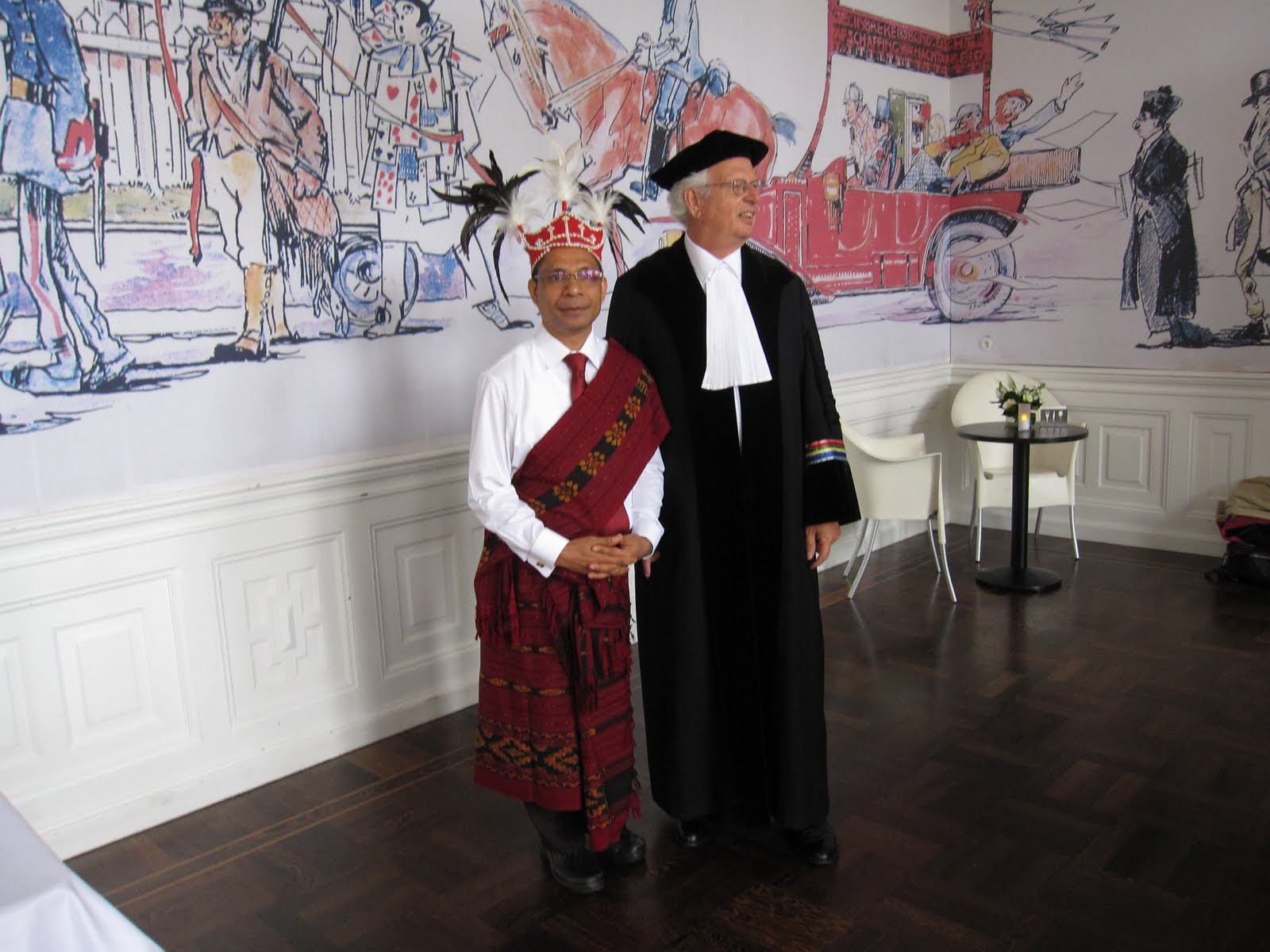
On 13 October 2011 a meeting was organised in Brussels by the Polish Presidency of the European Community, COMECE (the office of the European Bishops at the EU) and the Indonesian Embassy. Major guests was a small delegation of three guests from Indonesia: Prof. Atho Mudzhar, between 2002-2010 Head of the Research and Development Section of the Ministry of Religion, now teaching the UIN, Universitas Islam Negeri Syarif Hidyataullah of Jakarta (where he shares a room with our old friend Husni Rahim). Second was Prof. Margaretha Hendriks, former president of the Synod of the Moluccan Protestant Church and now Dean of Theology at the Christian University in Ambon. Third was Dr. Toni Wanggai, Nahdlatul Ulama head in Papua and also rector of the Papua Branch of the UIN Jakarta.
Topic of the discussion was the Freedom of Religion as enshrined in the Indonesian Constitution. I was invited to give a first talk of some 30 minutes. I stressed that religion or belief in God is mentioned twice in the 1945 Constitution. First it is mentioned in the preamble where (belief in) the Unique Supreme Deity (Ketuhanan yang Maha Esa is mentioned as one of the five pillar or Pancasila of the Indonesian nation. We must understand this formula as a rejection of Islam or sharia: no Islamic State but also no secular state. Instead, Indonesia considers religion/spirituality, personal belief in God as a positive aspect of society, without binding this to one concrete religion. Further, in article 29 individual freedom of religion and faith is firmly guaranteed.
In its implementation these principles were still quite broad in the Soekarno period (1945-65) when Pancasila was even considered as compatible with Communism. But after 1965 religions, especially the 'big five' have gained more status and it has become more or less necessary for Indonesians to formally become member of one of these five religions. No marriage is possible without this and even no identity card can be obtained in practice.
Various implementations of freedom of religion can be discussed as recent issues. I mentioned the 2003 Law of Education where it is stipulated that children must receive religious education according to their (and their parents') religion. The Catholics have finally accepted this rule as in line with the religious tolerance as [preached by Vatican II and here I quote Prof. Magnis Suseno who publicly defended this position. More problems are related to the two decrees of 2006 where at the level of provinces and districts Committees for Religious Harmony or FKUB (Forum Kerukunan Ummat Beragama) are instituted which have authority in permits for religious buildings. The definition of religious buildings is quite complicated. I quote my text:
The FKUB must issue permits for the construction of new places of worship with the condition that at least 60 adherents in a village or district of a city must support this house of worship. The village head must warrant this number of 60 adherents. Also a recommendation of FKUB at district level must be issued for each new place of worship. In the subsequent debate it was emphasised that Protestants with their large number of different denominations were in a difficult position as well as other minority religions, because a majority could obstruct the opening of new places of worship. Besides, the definition of houses of worship is not clear. Many Catholics come together in small groups in private houses to pray the rosary, to have meetings of Basic Ecclesial Communities, for choir rehearsals or just to prepare for Sunday Mass: are such meetings to be considered as worship and so the garage of a private house to be seen as an illegal house of worship? Militant Muslim groups, especially FPI, Forum Pembela Islam or the Muslim Defence Front, have set private houses on fire in Jakarta and West Java with these accusations.
In her reaction Mrs. Hendriks emphasized the problem of the many Protestant denominations that she finds `annoying` also in her region because so many different churches are now under construction. Atho Mudzhar explained that there are two terminologies: rumah ibadah of Houses of Worship for the larger buildings that need officials permits (mosques, churches), while the smaller ones tempat ibadah or places of worship (musalla, kapela) do not need special permits, because they are only used by one family or just a small neighbourhood.
Two suggestions for control of interreligious conflicts were suggested: the most important is a clean and effective police force, free from corruption and really intended to protect citizens. This was discussed related to the attacks on members of the Ahmadiyya movement who until 2008 could live quite peacefully during more than seven decades in West-Java but then were attacked by 'Muslim' gangs. Another suggestion was a decrease in the importance of religion in general:
The public role of religion increased dramatically in the New Order period after 1965. Here also the possibility of inter-religious conflicts arose, especially in the turbulent era preceding the fall of President Suharto continuing during the first decade after his resignation. Dr. Mujiburrahman, a lecturer at the State Academy of Islamic Studies in Banjarmasin, wrote a doctoral dissertation on this process at Utrecht University under the title Feeling Threatened. He analyzed the fear of Muslims towards Kristenisasi, loosing Muslim dominated territories to growing numbers of Christians, while the Christian minority fears that they will lose freedom to express their religion in regular churches, and that they will have to dress and live in an Muslim way as in a quasi Muslim state.
In 1996 the Catholic priest, architect, novelist and social activist Y.B. Mangunwijaya made an odd statement about the condition of his country. In his opinion there is ‘too much religion in Indonesia’. Beginning with his own Catholic Church, he complained that it is much too concentrated on its internal affairs, on its own community and also on its position in society. Here we may think about the slogan of Ignatius Kasimo, founder of the Catholic Party who always stressed that the Catholic Party was not founded to support and strengthen the condition of the Catholics alone, but for the bonum commune, the common prosperity of the whole nation. Many observers, both Muslims like members of the Liberal Network, Jaringan Islam Liberal as well as non-Muslims feel that during the last decade sometimes a narrower interpretation of the broad and inspiring formula of the 1945 Constitution has gain political backing. I am struck how the view of JIL is parallel to that of Soekarno. These Muslim liberals state that creed and cult belong to the private sphere, the concern of individuals only where the State must not interfere, while religion's ethical and civilising role belongs to the public sphere in open debate. Soekarno wrote letters from exile in Ende, Flores, back in the 1930s stating precisely this. Sure, Sukarno was "instrumentalising" Islam; but his "theology" is interesting too. And We should consider Soekarno as the main interpreter of Pancasila and the 1945 Constitution.
In the 1980s, while I was teaching at the State Institute of Islamic Studies Syarif Hidayatullah in Jakarta, my rector, Prof. Harun Nasution wrote a quite challenging small book on ‘Reason and Revelation in Islam’. He analysed the question ‘Are all aspects of life and all knowledge to be found in the Qur’an?’ Nasution stated bluntly that the Qur’an does not provide us with a clear system for political and economic life. Again and again the Qur’an repeats sentences like ‘there is in nature a sign for people who reflect’ (la ayat li kaumin yatafakkarūn, Q. 16:69; also 42:12-13). There is a modest role for religion in worship, in ethics, but in many fields human beings have to find their own way. We should respect but not exaggerate the role of religions. Even more: we should not be blind to the negative side that is also included in the practice of religion.
At the end of the formal exchange of ideas (which lasted from 9/11.30AM) the issue of Blasphemy Laws was discussed. Apparently there had been some debate about the Law of 1965 again last summer, but we did not really go deep into this issue under this label.
After the formal session there was a lunch between 12.30-14.30, in fact a second more informal session where more personal exchange was possible. This is a very nice protocol in the diplomatic life of Brussels.
After the meeting I asked myself about the real meaning of such event. The three Indonesians had arrived on Wednesday 12, but left one day before. They were planning to return on the 15th. Just for a meeting of some 5-6 hours. The ambassador stressed that Europe is important for Indonesia: to have bigger export quota, to remove Indonesia from a black list as an attachment to the Schengen agreement. In the discussions it became clear that Freedom of Rewligion is only part of a large social process an d that it should not be discussed too isolated. Anyhow, for me it was a special experience, not talking with academics, but in a political environment; not about the processes of the past that created the present, but to talk with politicians about what is good for the next future.
vrijdag 14 oktober 2011
From Fragmenta Islamic to a true History of Indonesian Islam?
According to my memory Ben Boland once wrote that there is no big theory, even not e true general history of Islam in Indonesia, written by a Dutch scholar. Commenting on a book by G.F. Pijper he once wrote that the only result we have to present the scholarly community is Fragmenta Islamic. I could not find the original place of the quote, but I several though about this remark when reading a very important new book by Michael Laffan, The Makings of Indonesian Islam: Orientalism and the Narration of a Sufi Past (Princeton University Press, 2011, 301 pages).
The book wants to give two broad histories: 1) a history of Indonesian Islam according to the many written sources consulted by Laffan; 2) a history and critique of Western studies of Indonesian Islam. the book is not about independent Indonesia and not about Indonesian scholars (no Taufiq Abdullah, Deliar Noet, Alfian). It ends with the Dutch scholars of the 1930s, G.F. Pijper and Schrieke. It only has a few remarks about Clifford Geertz, not much about Anthony Johns and Merle Ricklefs who both in a very different way supported the thesis of a mystic character of the Islamic past of Indonesia. It is not a book for the beginning student of Islam in Indonesia. It is a long essay on many scholars, officials, missionaries who wrote about Islam and, of course, writes at length about the towering figure of Snouck Hurgronje. I have to admit that I found it very difficult to read: it is a very ideological or abstract theoretical discussion of rather down to earth and sober writing Dutch scholars who did not like too much theoretical discourse. Therefore it seems quite often very generalizing. From time to time, however, he has keen information about concrete facts as well. On p. 69 he criticizes a passage in my Dutch Colonialism and Indonesian Islam, p. 33/34 where I suggest that the Malay text of Book of Thousand Questions was not directly known to Van Eck and his informants in the archipelago.
dinsdag 20 september 2011
A Celebration of Moses: Fredrik Doeka's Enduring Mission
On 20 September 2011 Fredrik Yosep Apeles Doeka, born in Alor, 1967, defended his doctoral dissertation at Utrecht University's Department of Religion. It was the end of a process that started in 1998 when Doeka came to Amsterdam for his Masters' Degree at the Free University of Amsterdam. Anthony Wessels was his tutor in Amsterdam, but he came regularly to Utrecht for Indonesian Islam and Qur'anic Studies. In 2000 he finished his MA with a nice thesis on Muslim Sufism. Born in a mixed Muslim-Christian family on the island of Alor (50,000 inhabitants, some 25% Muslim, 25% Catholics, the rest Protestant, but all still imbedded in traditional Alor ideas and rituals) he had studied theology in Jakarta in the late 1980s and early 1990s, has been a Protestant pastor in Labuan Bajo, Muslim stronghold in Catholic Flores. His wife is also a minister, at this moment in the prominent position of Secretary of the Synod of the GMIT, Timorese Protestant Church.

Doeka started in 2006 with the research on the reception and interpretation of Moses in Indonesian Muslim and Christian sources. His major sources were the five great Qur'an Commentaries (Zainal Arifin Abbas cs, Hamka, Hasbis ashShiddieqy, Departemen Agama, Quraish Shihab), the two great Qisasul Anbiya (Malay and Javanese) and the many books for children, comics etc. he found in various places, shops and libraries in Indonesia. It has always been my idea that we should just start reading and only draw conclusions and more general theories after our confrontation with the material. This is sometimes diffgicult, because Qur'an commentaries are quite encyclopaedic works and the Qisasul Anbiya also present the material in an anecdotic way. Therefore it was a little bit difficult to come to more general conclusions. These were mostly taken from theological discourse, about theology of religions and theories of dialogue: Moses is not superseded by the great figures of Islam and Christianity, Muhammad and Jesus, but has retained his own role in these religions. Sometimes this can be seen in his mystical quality. He was the one who spoke directly to God, other prophets received their messages through Gabriel. Moses was not easy, he was critical and debated with God: he is also the image for the seeking man. Vatican II has given an eminent position to Abraham and Mary in the dialogue with Muslims. But the Jordanian Document A Common Word has taken the word of Moses as its central theme: love God and your neighbour.


Above four pictures taken this day in the ceremonial building of Utrecht University; the Academiegebouw: Fredrik standing in Alor attire with Vera Daud Nolte and Jeannette Boere the two paranymphs. In the middle I read the second part of the laudatio, after Dr. Freek Bakker, co-promotor had read the first part in English. This second part was in the style of a Malay Syair:
Untuk Dr. Fredrik Doeka, 20 sept. 2011
Fredrik Doeka sekarang sudah doktor fi’din
Berkelana jauh-jauh ke negara dingin
Dari isteri, anak-anak dapat izin,
Asal tetap minal mu’minin
Fredrik Doeka is now a Doctor of Theology
He travelled far away to a foreign country
His wife and children consented in his journey
as long as he would stay in the faithful community
Fredrik mirip sang Pangeran Mesir
Musa juga mondar-mandir
Mencari hikmah di padang pasir
Begitu Doeka ke Belanda, saleh dan kafir
Fredrik is close to the Egypt's Prince
Moses also went here and hence
sought wisdom in desert and behind fence
So, Doeka arrived among the Dutch, pious and without any sense
Berbeda juga dari Musa, si sarjana Doeka:
Daging sama sekali tidak suka
Burung puyuh, kambing tidak mau luka
Vegetarian itulah cara yang cocok, sempurna
This Doeka differed from Moses very much,
No meat, he did not like that or such
Quails and manna, not on his table, no touch
Vegetarian that he likes as Indonesian or Dutch
Muslim ibunya, bapanya Kristen untuk agama
Fredrik, ya mau semua sama
Dapat gaji dari Kristen, mengajar di Artha Wacana
mengajar Islam sebagai matapelajaran utama
His mother was Muslim, his father's faith was the Christian stream.
Fredrik, to practice them both, is his dream.
Get's his salary from Christians, at Artha Wacana's regime
but teaches Islam as his major theme
Doeka lahir di Alor, pulau yang sedang
Mencari ilmu di Jakarta, kota gedang
Puncak ilmu dapat di negeri kecil, sekarang pulang!
Baru di Kupang lalu berkembang.
Doeka was born in Alor, the little island
sought wisdom in Jakarta, the biggest in his own land
came to the small country of Holland,
now in Kupang he will truly expand.

Fredrik Doeka with his two promotors and Mrs. Pauline Steenbrink who had him for four periods of two months as a guest in our house. With good final results!

In the evening there was a social event in our house where Mrs. Gracia Nolte (born in the Netherlands, but from parents born in Roti/Timor), played a traditional Timorese harp.
I do hope that there will be a lasting ('enduring') development for Doeka in the field of teaching, research and interreligious relations in East Indonesia, where Muslims are a strong minority but Christians have majority positions. His feeling for the narrative side of religions can be seen in this dissertation. Besides, he has strong ties with the traditional culture and these local traditions, when respected and honoured by the world religions, can also be the binding factor between the international religions.

Doeka started in 2006 with the research on the reception and interpretation of Moses in Indonesian Muslim and Christian sources. His major sources were the five great Qur'an Commentaries (Zainal Arifin Abbas cs, Hamka, Hasbis ashShiddieqy, Departemen Agama, Quraish Shihab), the two great Qisasul Anbiya (Malay and Javanese) and the many books for children, comics etc. he found in various places, shops and libraries in Indonesia. It has always been my idea that we should just start reading and only draw conclusions and more general theories after our confrontation with the material. This is sometimes diffgicult, because Qur'an commentaries are quite encyclopaedic works and the Qisasul Anbiya also present the material in an anecdotic way. Therefore it was a little bit difficult to come to more general conclusions. These were mostly taken from theological discourse, about theology of religions and theories of dialogue: Moses is not superseded by the great figures of Islam and Christianity, Muhammad and Jesus, but has retained his own role in these religions. Sometimes this can be seen in his mystical quality. He was the one who spoke directly to God, other prophets received their messages through Gabriel. Moses was not easy, he was critical and debated with God: he is also the image for the seeking man. Vatican II has given an eminent position to Abraham and Mary in the dialogue with Muslims. But the Jordanian Document A Common Word has taken the word of Moses as its central theme: love God and your neighbour.
Above four pictures taken this day in the ceremonial building of Utrecht University; the Academiegebouw: Fredrik standing in Alor attire with Vera Daud Nolte and Jeannette Boere the two paranymphs. In the middle I read the second part of the laudatio, after Dr. Freek Bakker, co-promotor had read the first part in English. This second part was in the style of a Malay Syair:
Untuk Dr. Fredrik Doeka, 20 sept. 2011
Fredrik Doeka sekarang sudah doktor fi’din
Berkelana jauh-jauh ke negara dingin
Dari isteri, anak-anak dapat izin,
Asal tetap minal mu’minin
Fredrik Doeka is now a Doctor of Theology
He travelled far away to a foreign country
His wife and children consented in his journey
as long as he would stay in the faithful community
Fredrik mirip sang Pangeran Mesir
Musa juga mondar-mandir
Mencari hikmah di padang pasir
Begitu Doeka ke Belanda, saleh dan kafir
Fredrik is close to the Egypt's Prince
Moses also went here and hence
sought wisdom in desert and behind fence
So, Doeka arrived among the Dutch, pious and without any sense
Berbeda juga dari Musa, si sarjana Doeka:
Daging sama sekali tidak suka
Burung puyuh, kambing tidak mau luka
Vegetarian itulah cara yang cocok, sempurna
This Doeka differed from Moses very much,
No meat, he did not like that or such
Quails and manna, not on his table, no touch
Vegetarian that he likes as Indonesian or Dutch
Muslim ibunya, bapanya Kristen untuk agama
Fredrik, ya mau semua sama
Dapat gaji dari Kristen, mengajar di Artha Wacana
mengajar Islam sebagai matapelajaran utama
His mother was Muslim, his father's faith was the Christian stream.
Fredrik, to practice them both, is his dream.
Get's his salary from Christians, at Artha Wacana's regime
but teaches Islam as his major theme
Doeka lahir di Alor, pulau yang sedang
Mencari ilmu di Jakarta, kota gedang
Puncak ilmu dapat di negeri kecil, sekarang pulang!
Baru di Kupang lalu berkembang.
Doeka was born in Alor, the little island
sought wisdom in Jakarta, the biggest in his own land
came to the small country of Holland,
now in Kupang he will truly expand.
Fredrik Doeka with his two promotors and Mrs. Pauline Steenbrink who had him for four periods of two months as a guest in our house. With good final results!
In the evening there was a social event in our house where Mrs. Gracia Nolte (born in the Netherlands, but from parents born in Roti/Timor), played a traditional Timorese harp.
I do hope that there will be a lasting ('enduring') development for Doeka in the field of teaching, research and interreligious relations in East Indonesia, where Muslims are a strong minority but Christians have majority positions. His feeling for the narrative side of religions can be seen in this dissertation. Besides, he has strong ties with the traditional culture and these local traditions, when respected and honoured by the world religions, can also be the binding factor between the international religions.
dinsdag 30 augustus 2011
The Jesus Verses
In 2006 I published a book on the Jesus Verses in the Qur'an. It has a translation of the 100 verses about Jesus, a commentary related to the context of the various surah's and some suggestions for further development of a doctrine/image about Jesus. Many of the old and established ideas are repeated here, but one new theory has been put forward: in imitation of the theory of Snouck Hurgronje about a changing perception and role of Ibrahim in the 'earlier' and 'later' texts of the Qur'an, I also suggest here a change in perspective about Jesus.
In surah 19, one of the earlier texts, Jesus is seen only in a positive way, without polemics (if we take the verses 34-40 as a later interpolation). The death of Jesus is mentioned more or less as a refrain, repeating the text on John:
19:15 (on John/Yahya)
may peace be upon him on the day that he was born,
on the day that he dies
and on the day that he will be raised up again to life
19:33 (on Jesus/Isa)
peace is with me on the day that I was born,
on the day that I die
and on the day that I will be raised up again to life.
It is quite interesting that 19:33 is also on the Dome of the Rock in Jerusalem, but then in the third person, exactly in the same wordings as 19:15 on John!
The idea about Jesus who did not die on the cross can be read in 4:157 where the text says about the Jews:
They have not killed him. And they have not crucified him. This can also be read as it was done in surah 8:17 about Muslim killed at Badr. The Qur'an says here to the unbelievers: You have not killed them, I, God, have killed them.
The interpretation of the believer can accept such strong wordings.
I thank Dr. Simon Rae of Dunedin/New Zealand, who made a clear translation and also Dr. Varghese Manimala of the Henry Martin Institute in Hyderabad who organized this English translation, published atMedia House, Delhi. See their website:
www.mediahousedelhi.com.
Selamat 1 Syawwal 1432!
This year it was a quite sober and quiet month of Ramadan. The Dutch local governments were much less generous in the previous years and did not give ample subsidies for iftar meals that blossomed during the last decade as feast of integration of Muslims with other citizens of the country. Non-Muslims were asked to give talks preceding these Ramadan meals and to join the ritual meals. I had quite a few of these occasions last years, where a light speech with some spirituality and jokes was necessary to keep people waiting for the decisive moment of the first date or drink. This year it was also more difficult because of the late time of the meals: starting at 9.45 PM only in the beginning of Ramadan. Somewhat moving forward to shortly after 9 PM. It was a less festive, perhaps even less strictly religious Ramadan: not so much about this religious obligation in the media, in public space. Like in the Middle East, where religion does play not an important role in the politics of Libya, Syria and even Egypt. That would be a nice development!
A wonderful present for Idul Fitr was the dissertation by Fredrik Doeka from Kupang, East Indonesia. Because I will reach the age of 70 years in January 2012, he will be the past Ph.D. Student to defend a dissertation.
His work is about Moses, a giant figure in the religious history of mankind and celebrated by Jews, Christians and Muslims alike. Fredrik studied the Indonesian perceptions of Moses, worked with Qisasul Anbiya in Malay and Javanese, gave an analysis of the five major Indonesian Qur'an Commentaries, but he also paid much attention to the comic books for children and the cover of his dissertation shows some examples of these literature for children. Besides, he sketches the major themes discussed by Indonesian Christians in their view of Moses. Not the Abrahamic religions, not the different perceptions of Jesus and Muhammed, but Moses here as uniting the two largest religious communities of the world.
There is no Idul Fitr without apologies and excuses. A small devil played with the cover of the book and now we see the hybrid Nederlands. Mohon maaf lahir batin! A'udhu minal syatanil rajim!
A wonderful present for Idul Fitr was the dissertation by Fredrik Doeka from Kupang, East Indonesia. Because I will reach the age of 70 years in January 2012, he will be the past Ph.D. Student to defend a dissertation.
His work is about Moses, a giant figure in the religious history of mankind and celebrated by Jews, Christians and Muslims alike. Fredrik studied the Indonesian perceptions of Moses, worked with Qisasul Anbiya in Malay and Javanese, gave an analysis of the five major Indonesian Qur'an Commentaries, but he also paid much attention to the comic books for children and the cover of his dissertation shows some examples of these literature for children. Besides, he sketches the major themes discussed by Indonesian Christians in their view of Moses. Not the Abrahamic religions, not the different perceptions of Jesus and Muhammed, but Moses here as uniting the two largest religious communities of the world.
There is no Idul Fitr without apologies and excuses. A small devil played with the cover of the book and now we see the hybrid Nederlands. Mohon maaf lahir batin! A'udhu minal syatanil rajim!
dinsdag 9 augustus 2011
Islam in Contention, between Abangan, Moderates and Salafi
Last weekend we had two visitors for dinner in Utrecht. Kobayashi Yasuko from Japan has arrived in the Netherlands for her yearly research in Dutch archives and libraries on Muslim in Indonesia in the period 1930-1960. She concentrates on the new magazines like Pedoman Masyarakat (and the new style of Islam, not so scripturalist, more for the new middle class people who want practical rules for a balanced life). She also looks, especially in the archives, for the influence of the Japanese pre-war relations, the effects of the Pacific War on Indonesian Islam as well as the turbulent history of Kartosuwirjo and other militant Muslims in the late 1940s and 1950s when modern Indonesia started to take shape.
Willem van der Molen is busy with a special manuscript of the Old Javanese Ramayana: the lontar text of the Ramayana, as written shortly after 1500. He is invited to come to Tokyo and so the two came together at a meal in Utrecht. Talkign about the daily affairs of recent past and how to manage living in Tokyo, Japan, but also the Netherlands.
Yasuko brought a special gift: the new book published by the Wahid Foundation. Islam in Contention is a more or less academic presentation of the basic ideas of Ilusi Negara Islam, that is written in a very simple, simplifying and somewhat polemic style against the wahabisasi, the growing influence of Wahhabi ideas in modern Indonesia.
This new Contention-book is the result of a conference in Kyoto, 2008 and is clearly academic in style, arguments, documentation and suggestions. It is quite striking that Japanese and Indonesian scholars here use the same style, vocabulary and purpose: to sum up, analyze and even denounce the recent developments in Indonesian Islam as a betrayal of the more moderate and open tradition of Islam. There is very little Muhammadiyah. Often Muhammadiyah is identified with Din Syamsuddin and even this leader is more or less identified with Hisbu Tahrir sympathies. The actual picture may be more complicated.
In former times (the Clifford Geertz era) Indonesia was divided in santri and abangan (we leave the Priyangan aside, because it is now generally accepted that they are not relevant). Geertz introduced also the terminology santri kolot vs. santri moderen. As to difference between NU and Muhammadiyah this never was relevant: NU never was simply traditional, backward, but was more lenient towards differences within the Muslim community.
This is nicely illustrated by the article that Yasuko wrote in the book. It is about fatwas about women, issued by NU leadership between 1926-2004. Not all fatwa decision by the NU committee could be gathered: for six years the original documents are missing (I wrote in the margin: truly messy NU administration). NU has no personal fatwas, but collective ones, also truly NU because the individual should first of all be a member of a group. Yasuko emphasizes that the Bahtsul Masa'il is an all male body where 'women's desires are almost ignored. I found one of the strangest opinions that theoretically a pregnancy may go on for four years (300). The Bahtsul Masa'il is changing in its judgments. Remarks about segregation of sexes outside home have disappeared from their decisions after 1971 (303). "NU was six years late (compared to MUI) in issuing legal opinions concerning concrete methods of contraception" (304), more or less in line with the Roman Catholics. Polygamy is still a taboo among NU ulama, and here the CLD-KHI, a quite radical counter proposal in the field is Islamic law is quite refreshing.
The book as a whole has many detailed studies about the loval introduction of shari'a (Perda Syari'ah, about PDI, Hizbut Tahrir, PKS (considered as opportunistic and realistic. A wonderful opportunity to bring updated information to people who are not in close touch to common daily debates in Indonesia. Highly recommended. Thank you, Yasuko, for bringing it to Utrecht!
Remains the question about the disappearance of the abangan. Do we have new abangan people in Indonesia? People not so interested in Islam or in any formal religion at all? In the 1960s the Catholics, especially Jesuit Jan Bakker, hoped that abangan would become more or less a formal religion in the aliran kepercayaan/kebathinan. But they disappeared together with the abangan. Are the NGOs, more interested in social science and politics the new abangan? There is some more interest in eastern spiritulity, yoga, but it is not widespread.
And what about Christians in Indonesia: do they have abangan style among them? Traditional customs are tolerated as adat, but can be seen as some kind of Christian abangan in Flors, Timor, Minahasa, Papua.
Dr. Agus Setiabudi and reading of the Old Testament
Yesterday, 5 August 2011, Agus Setiabudi defended his doctoral dissertation at the Theological School of Kampen, officially the PThU, Protestantse Theologische Universiteit. The title of the dissertation is:
Taking its Shape. Towards an Indonesian Old Testament Theology. The book discusses the four volume work by Christoph Barth, son of the famous Karl Barth, who for about 25 years taught in Indonesia, Banjarmasin and Jakarta. His Theologia Perjanjian Lama is still reprinted and used at theological schools in Indonesia. Setiabudi analyzed this book, the English translation and some 20 dissertations by Protestants scholars of Indonesia. He concluded that the very strict orthodox theology of Christoph Barth is somewhat altered by the Indonesians: they have more feeling for the value of local traditions and do not see the Old Testament as an isolated truth, towering above all the sins and nonsense of human people, but try more to write biblical interpretation in harmony with their culture. This is a nice description of recent history of Indonesian Protestant theology.
Several readers were surprised to see that a similar book: Walter Lempp's multi-volume Tafsir Perjanjian Lama was not taken into consideration. In fact the two scholars share the same academic and spiritual tradition. Several readers were also surprised that the Catholics were not mentioned at all: no Cletus Groenen, John Prior, Stefanus Darmawijaya (with his nice comparison of the panakawan and the ebed Jahwe or Servant of God) and nothing about the much younger Jesuit Deshi Ramadhani.
Setiabudi wants a specific Indonesian Old Testament Theology and writes at various placed in his book that Islam must be an important context for Bible Interpretation. But I am afraid that he knows very little about the strong biblical background of the Qur'an, little about the extensive reference to Adam, Noah, Abraham, Moses, David and Jesus in the basic text of the Muslim community. In fact, biblical scholars could have an important role in the Indonesian contextual theology, but the European tradition is so strong, that not yet much can be seen here.
Gerrit Singgih will receive an honorary doctorate in Kampen in December. Congratulations! Gerrit was co-promotor in Kampen. Above he is shown together with Barend Drewes, for many years teaching New Testament interpretation in Indonesia.
There is a famous Latin proverb: Timeo hominem unius libri. It must be translated as: I fear someone who only reads/sticks to one book. Scripturalism is the word coined by Clifford Geertz for any style of orthodoxy that claims to return to the text of one book alone. In reality, it is always new interpretations that rise. We should be realistic and not stick to one book alone, Bible or Qur'an.
Abonneren op:
Posts (Atom)